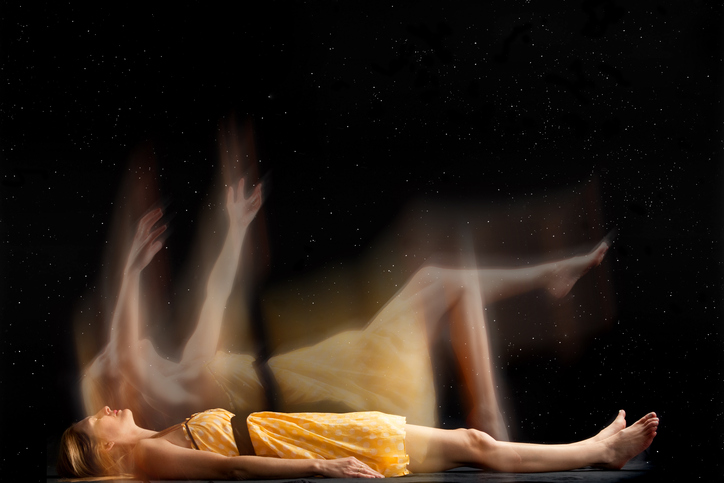
Photo by sdominick/Getty Images
What actually happens when we die? When
Gregg Nome was 24 years old, he slipped into the churn beneath a
waterfall and began to drown, his body pummelled against the sandy
riverbed. What he saw there surprised him. Suddenly, his vision filled
with crystal-clear scenes from his childhood, events he had mostly
forgotten, and then moments from early adulthood. The memories, if
that’s what they were, were vivid and crisp. Was he reliving them? Not
quite. They came at high speed, almost all at once, in a wave. And yet
he could process each one individually. In fact, he was able to perceive
everything around him: the rush of the water, the sandy bed, all of it
brilliantly distinct. He could “hear and see as never before,” he
recalled later. And, despite being trapped underwater, he felt calm and
at ease. He remembered thinking that prior to this moment his senses
must have been dulled somehow, because only now could he fully
understand the world, perhaps even the true meaning of the universe.
Eventually, the imagery faded. Next, “There was only darkness,” he said,
“and a feeling of a short pause, like something was about to happen.”
Nome recounted this story at a support group in
Connecticut, in 1985, four years after the experience. He had survived,
but now he hoped to understand why, during a moment of extreme mortal
crisis, his mind had behaved the way it did. The meeting had been
organised by Bruce Greyson, now a professor emeritus in psychiatry at
the University of Virginia. (Some of the group’s members had responded
to an ad Greyson placed in a local newspaper.) As Nome spoke, Greyson
sat in a circle of 30 or so others, as if at an AA meeting, listening
intently, nodding along.
Greyson had been hearing of events like these
for years. A month into his psychiatric training, in the 1960s, he had
been “confronted by a patient who claimed to have left her body” while
unconscious on a hospital bed, and who later provided an accurate
description of events that had taken place “in a different room”. This
made no sense to him. “I was raised in a scientific household,” he says,
over Zoom. “My father was a chemist. Growing up, the physical world was
all there was.” He felt certain someone had slipped the patient the
information. He also thought, “What does that even mean, to leave your body?”
For years, he tried to put the account behind
him, but repeatedly he faced heady stories of people experiencing
other-worldly events, either when they had been pronounced clinically
dead or thought they were close to it, before being wrestled back to
life. In the 1975 best seller Life After Life, the psychiatrist
Raymond Moody, once a colleague of Greyson’s, labelled these episodes
“near-death experiences”, or NDEs, a term that stuck. “It occurred to me
for the first time that this wasn’t just one patient,” Greyson says.
“It was a common phenomenon.” He became fascinated by the qualities of
the episodes and the questions they raised, including perhaps the
biggest of all: what actually happens when we die? “I plunged in,” he
says. “And here I am, 50 years later, trying to understand.”
Greyson is 74 as of the time of this writing.
When we talk, he is at home in Charlottesville, Virginia, waiting out
the pandemic in a pressed shirt and tie, kind and affable. Over the
years, he has collected hundreds of near-death experiences, he says,
either from people who, aware of his research, have volunteered their
stories, or from patients who happened to have episodes in hospital. In
those cases, Greyson’s process is nearly always the same: he sidles up
to the bedside and gently withdraws information. “I ask: ‘What’s the
last thing you remember before you blacked out?’” he says. “Then:
‘What’s the next thing you remember after that?’ And finally: ‘And what
do you remember between those times?’”
Not everyone reacts well to the questions; most people stare at him
blankly. “But around one in five will say, ‘Well, you know, I thought I
saw my father, who died 20 years ago,’ and I say, ‘Tell me about that’ –
and I let them go…”
Greyson presents his research in a book, After,
which is bound by a series of case studies. The accounts are mystical,
like those we know from TV and books, but there are common themes. After
a bad reaction to anaesthesia, one patient recalled: “I found myself in
a meadow, mind cleared, identity intact.” The meadow, she went on, was
“lit with this glorious, radiant light, like no light we’ve ever seen,”
and “a gentle, inner glow shone from each and every plant.” Most
episodes involve similar feelings of wonder, mental clarity and bliss,
Greyson says. Some people recall out-of-body experiences, or report
travelling through a long tunnel; others meet entities they think of as
God or Allah or long-dead family members; some feel time bend and warp,
as though it were elastic. Once, a policeman who almost died during
surgery asked Greyson: “How do you describe a state of timelessness,
where there’s nothing progressing from one point to another, where it’s
just all there, and you’re totally
immersed in it?” Another person recalled: “The energy of my spirit
seemed to flow like a great whale gliding through a sea of silent
euphoria.”
It has been Greyson’s role as a psychiatrist to
provide a space in which “experiencers” feel comfortable retelling often
incomprehensible stories – though even when patients discover the
courage to try, they can struggle to find the right language. “When I
talk to near-death experiencers, one of the first things they say is: ‘I
can’t put it into words. There’s no way to express this.’” A frustrated
experiencer once told him that when he tried to recall events, “I
always fall short.” Another explained it would be difficult to describe
her experience because we live in three dimensions, and what she saw on
the border between living and dying seemed bigger somehow. Greyson has
found that sometimes people turn to painting or music to recall events,
as if true meaning can be shared non-verbally. But even that’s
insufficient. A subject once told Greyson that recalling his near-death
experience was like trying “to draw an odour with crayons”, which is to
say, basically impossible.
Given that near-death experiences happen with
limited warning, they are almost impossible to test. “We’re dealing with
a very short space of time,” Greyson says. A swimmer is trapped
underwater, a roofer falls from a ladder, a bystander, peering down at
their phone, is struck by a car. In After, Greyson points out
that his career has coincided with advances in brain-imaging technology,
including the emergence of fMRI scanners, which help neuroscientists
observe thinking in action. But equipment like that requires compliance:
an appointment is made, a patient agrees to sit still. What happens
when an experience occurs randomly, nowhere near a hospital? How do you
capture a moment as fleeting and unannounced as the point of near-death?
When I ask Greyson why he decided to publish After
now, after all these years, he explains that “we had to wait until we
had enough knowledge about near-death experiences to be able to
understand what was going on,” by which he means not that we know what
NDEs are, but that advances in science have allowed us to rule out a
heap of things they are not. “There are physiological hypotheses that
seem plausible theoretically,” he says, but none have stuck.
Are feelgood chemicals, like endorphins, released into the body at the
point of peril, creating euphoria? Does the brain become starved of
oxygen, prompting real-seeming fantasies? Do various areas of the brain
suddenly begin to work in concert to create strange, altered states?
Nobody knows for sure. “We keep thinking, ‘Oh it’s got to be this,’”
Greyson says. “No, the data doesn’t show that. ‘Oh, this then?’ Well, nope, the data doesn’t show that, either.”
At the University of Kentucky, the neurologist
Kevin Nelson, who, like Greyson, has spent years recording NDEs as a
kind of academic side-gig, thinks of the experiences as “a blending of
two states of consciousness – wakefulness and REM sleep – during a time
of great physical or emotional danger,” and argues that many NDEs are
“dream-like”, existing in a neurological “borderland”. (Fainting, he
added, might bring about similar experiences.) Other researchers,
including the late neurologist Oliver Sacks, have thought of NDEs as
“extremely complex” hallucinations, an idea that, if nothing else, seems
culturally accepted.
When Greyson mentions his research to
colleagues, he receives “a variety of reactions, from, ‘Are you out of
your mind?’ to ‘Oh, let me tell you about my near-death
experience.’” To formalise NDE research in the 1980s, he developed a
survey, the Greyson Scale, which has been translated into over 20
languages and is still in use. (Did you suddenly seem to understand everything? Did you feel a sense of harmony or unity with the universe?) And he has been published widely in respected medical journals. But he can have quirky ideas. In After,
Greyson writes: “I take seriously the possibility that NDEs may be
brought on by physical changes in the brain,” though he also accepts
that the mind might be able to function “independent” of it. There have
been reports of people experiencing near-death episodes while their
brains are inactive, he says, and “yet that’s when they say they have
the most vivid experience of their lives.” This doesn’t make sense to
him. Partway though our conversation, he asks: “Are these the final
moments of consciousness? Or the beginning moments of the afterlife?”
These kind of theories put Greyson on wobbly
ground among neuroscientists, who mostly agree the mind to be a product
of the brain. Of the afterlife, Nelson told me: “This claim is the most
extraordinary in science, and there is no ordinary, let alone
extraordinary, scientific evidence to support it.” (He added: “These are
matters of faith.”) Sacks called claims like these “anti-science”.
Daniel Kondziella, a neurologist affiliated with the department of
neurology at Copenhagen University Hospital, told me that if “people are
able to describe and report their experiences, even many years later”,
then surely “they have been processed by the brain and stored in its
memory centres.” (Like Nelson, Kondziella believes NDEs are somehow
related to REM sleep.)
Greyson knows that events in near-death
experiences are impossible to corroborate. “We can’t do research on a
deity,” he says, drily. But still, he finds it tough to dismiss wackier
theories, even if the data isn’t there. When I ask him what his current
logical understanding is, he looks resigned. “It seems most likely to me
that the mind is somehow separate to the brain,” he says, “and, if
that’s true, maybe it can function when the brain dies.” Then he adds,
“But if the mind is not there in the brain, where is it? And what is it?”
Near-death experiences are
not a new phenomenon. Socrates had one, according to Plato; Pliny the
Elder recorded another (in the first century); history is filled with
examples of mountaineers falling from cliffs and experiencing bliss
rather than terror. But we seem as enthralled now by their meaning as
ever, and they continue to be sprinkled liberally across popular
culture.
In 2020, my four-year-old son and I watched Soul,
the Disney film, which introduces the near-death experience to a new
audience, very young people, and examines consciousness, the afterlife,
and the imperceptible stuff that makes us us. (My son is convinced now
that when we die we ride an ethereal, very cool-looking travelator
toward a blinding light in the sky.) Often in these screen-based times,
we are encouraged to celebrate narratives that promote living the
“right” way, which tends to involve appreciating and accepting every
moment for what it is, and mindfully placing experiences and
relationships above the pursuit of power or prestige or material goods.
(Broadly speaking, this is the plot of Soul.) Most of us do not live like that, not entirely, and yet we feel like we should,
lest we waste our precious time on this planet. Which is why near-death
narratives fascinate us, and why they persist as events of interest in
the culture. They ask: “What would you do with your life, if you had
another chance?”
To Greyson, the impact near-death experiences
have on people’s lives has been his most surprising discovery. “I make a
living by trying to help people change their lives,” he says. “It’s not
easy to do. But here I’ve found an experience that, sometimes in a
matter of seconds, dramatically transforms people’s attitudes, values,
beliefs, and behaviours.” Often, these changes persist over decades. In
most instances, experiencers realise they are no longer afraid to die,
which “has a profound impact on how they live their lives”, because “you
lose your fear of life as well – you’re not afraid of taking chances.”
Greyson sometimes asks people to describe their partners before and
after an event, “and they’ll say, ‘Yeah, this isn’t the person I
married; this is someone different.’” He adds, “They see a purpose in
life they didn’t see before. I don’t know of anything else that
powerful.”
I ask for an example. “I’ve spoken to people who
were policemen,” he says, “or career military officers, who couldn’t go
back to their jobs, couldn’t stand the idea of violence.” I ask why. He
says, “The idea of hurting someone becomes abhorrent to them.” He
shrugs. “They end up going into helping professions. They become
teachers, or healthcare workers, or social workers.”
I ask if Greyson’s research has changed the way he thinks.
“I don’t think it’s changed me in terms of my
relationships with other people,” he says, “except it’s made me more
accepting, more open to unusual ideas.” As a psychiatrist, he remains
“aware of what it means to be psychotic”, but, he says: “I’m more
accepting of unusual thoughts that aren’t crazy, and it’s made me much
more conscionable with the unknown.
“I grew up without any kind of a spiritual
background,” he continues. “And I’m still not sure I understand what
spiritual means. I am convinced now, after doing this for 40, 50 years,
that there is more to life than just our physical bodies. I recognise
that there is a non-physical part of us. Is that spiritual? I’m not
sure. Spirituality usually involves a search for something greater than
yourself, for meaning and purpose in the universe. Well, I certainly
have that.”
After: A Doctor Explores What Near-Death Experiences Reveal About Life and Beyond, by Bruce Greyson, is out on 11 March (£16.99). Buy it for £14.78 at guardianbookshop.com
Alex Moshakis is a commissioning editor for Observer Magazine.